The Unfinished Obelisk in Aswan makes monumental stonework legible at the moment it failed. Still joined to the quarry, the abandoned block preserves a stage normally erased when a finished monument leaves its source. Fissures halted the work, turning an engineering loss into unusually direct archaeological evidence for selection, extraction and risk.
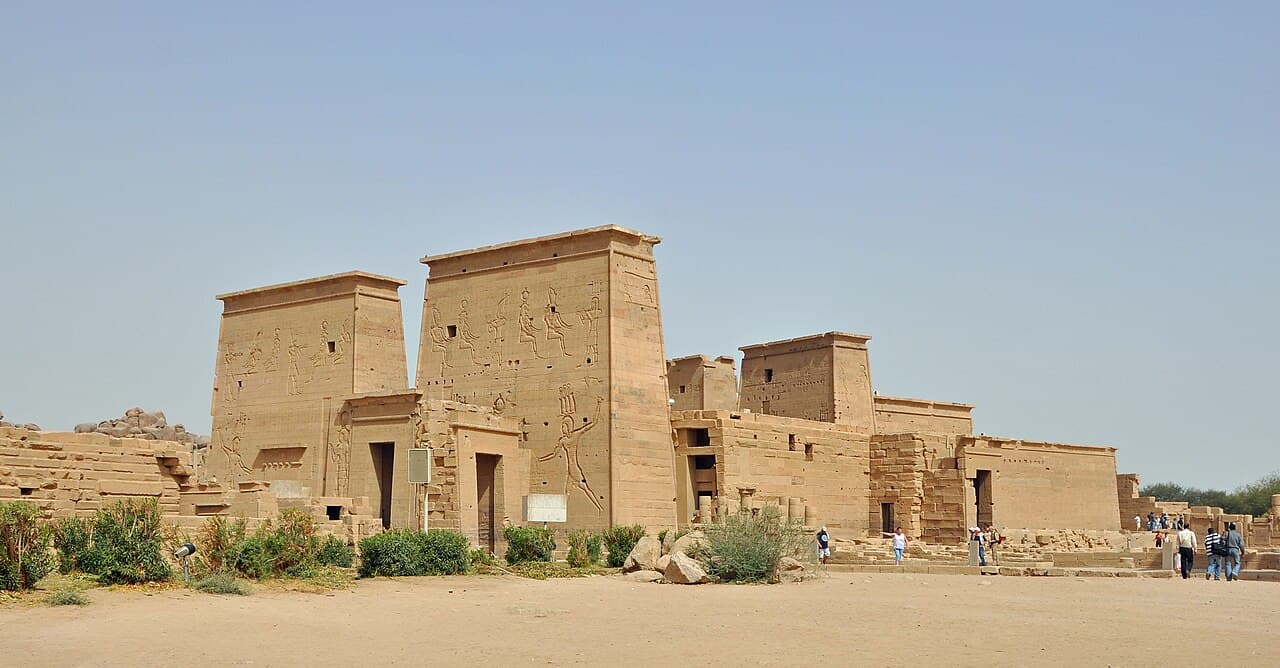
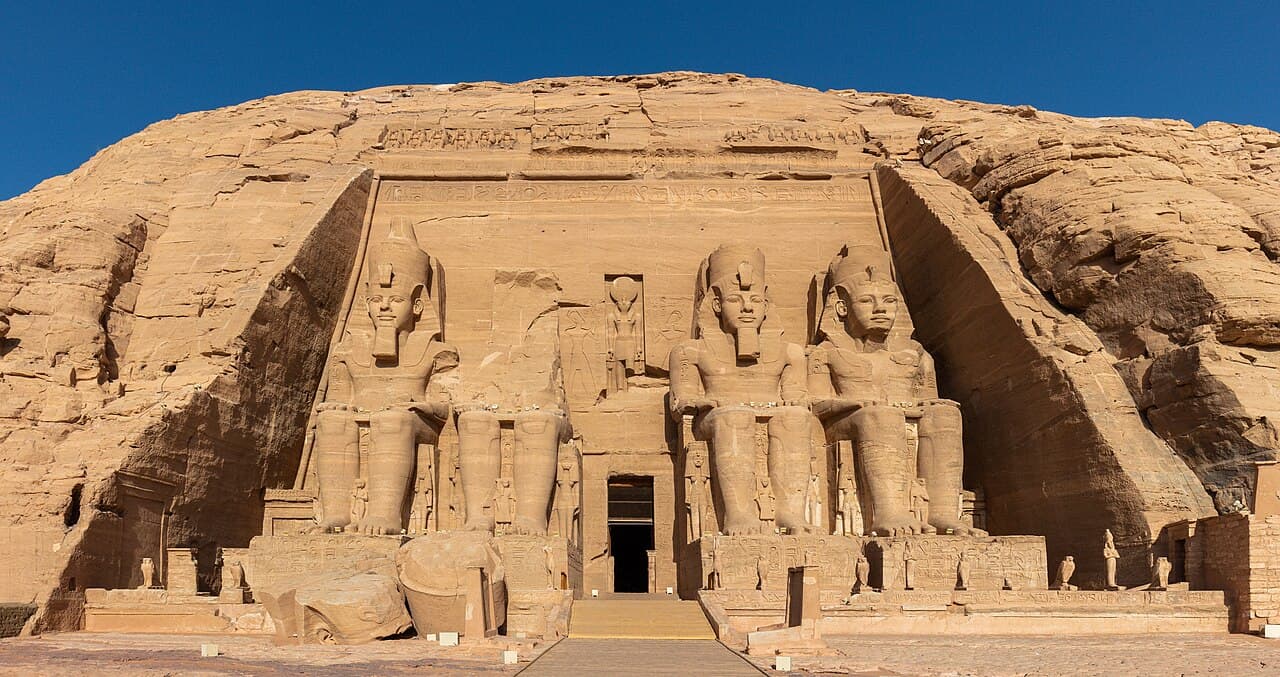
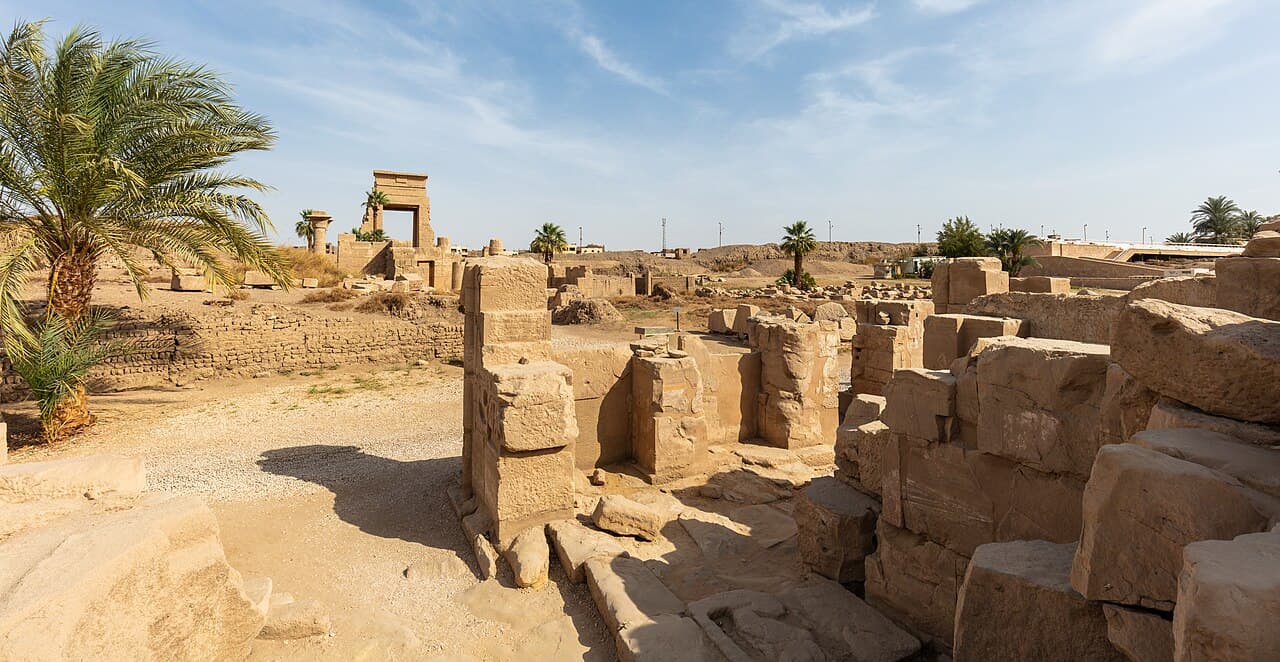
Following granite from quarry to temple requires caution. Aswan was a major source, and granite became obelisks, statues and architectural elements across Egypt, but a general material connection is not proof that every finished block came from this exact quarry. This feature traces a chain of decisions—reading stone, separating a monolith, shaping, transporting, erecting and reinscribing—while keeping the boundary between observed evidence and plausible reconstruction visible. The Karnak photograph shows a finished monumental context, not the Aswan quarry itself.
At a glance
Start here
- The Unfinished Obelisk preserves production evidence usually lost when a monument is completed and moved.
- A monolith concentrates risk because a hidden flaw can invalidate work already invested in the block.
- Transport and erection were separate engineering problems after extraction.
- Material provenance should be stated at the level the archaeological evidence supports, never assumed from appearance alone.
01
Start with stone still attached
The Ministry identifies the Unfinished Obelisk as a single granite block left in an Aswan quarry after flaws became apparent. Its attachment to the bedrock changes the evidence. A finished obelisk shows geometry, inscriptions and placement; the quarry shows how workers approached the mass before any triumphant erection was possible.
Look at the border between intended object and surrounding rock. Channels and worked surfaces define the proposed form while the underside remained part of the quarry. The key insight is negative: extraction was not a single lift but a progressive release. Until the block separated successfully, every earlier stage remained vulnerable to the material itself.
Sources: Egyptian Ministry of Tourism and Antiquities; Egyptian Ministry of Tourism and Antiquities02
Understand the risk of a monolith
An obelisk was conceived as one piece of stone, with a rectangular shaft and a pyramidion at the top. That unity gave the finished form visual power and solar associations, but it also concentrated engineering risk. A fissure could not be solved by replacing one small masonry unit; it compromised the intended monolith.
The unfinished block therefore documents quality control as much as ambition. Abandonment indicates that workers assessed the stone and stopped when the finished result was no longer viable. Calling it a failure is accurate only at the project level. Archaeologically, it exposes decision-making that a successful polished surface would conceal.
Sources: Egyptian Ministry of Tourism and Antiquities03
Separate shaping from moving
Even a successfully extracted block still had to be shaped, moved from the quarry, loaded for river transport, unloaded and raised at a destination. The sources used here establish Aswan’s quarry role and finished obelisks at Karnak, but they do not provide a complete manual for each operation. The honest reconstruction names the sequence without pretending every tool, ramp or labour arrangement is settled.
This separation prevents a common shortcut in monumental storytelling: leaping from “quarried in Aswan” to “placed at Karnak.” Between those statements lies the Nile, shifting loads, prepared landings and erection risk. Each transition required different knowledge. The absence of one surviving instruction text does not justify filling the gap with cinematic certainty.
Sources: Egyptian Ministry of Tourism and Antiquities; Egyptian Ministry of Tourism and Antiquities; UNESCO World Heritage Centre04
Read installed obelisks at Karnak
Karnak preserves obelisks within an architectural and political setting distinct from the quarry. The Ministry identifies Hatshepsut’s standing obelisk near the Hypostyle Hall area and places it among generations of royal additions. Once installed, stone became more than material: position, height, inscription and relation to temple axes expressed royal dedication and sacred meaning.
Compare the smooth, vertical finished form with the horizontal quarry evidence at Aswan. One emphasizes controlled arrival; the other exposes uncertain production. Do not claim that the photographed Karnak stone is the Unfinished Obelisk’s intended twin or assign it to the same extraction face without direct provenance evidence. The comparison works because the states differ, not because they are proven parts of one commission.
Sources: Egyptian Ministry of Tourism and Antiquities; Egyptian Ministry of Tourism and Antiquities05
Connect stone with temple axes
An erected obelisk gained meaning from placement. Karnak’s complex includes east-west and north-south relationships, while Luxor Temple is oriented toward Karnak and participated in the Opet procession. Monumental stone helped mark thresholds, focus sight lines and make a ruler’s intervention visible within an inherited sacred plan.
Material history and spatial history therefore meet at installation. Granite’s colour, hardness and polish mattered, but so did what the monument faced and which movement passed it. A quarry study answers where and how a stone began; a temple study asks what the finished element did within architecture. Keeping both questions produces a fuller account than admiring weight alone.
Sources: Egyptian Ministry of Tourism and Antiquities; Egyptian Ministry of Tourism and Antiquities06
Treat Aswan as a production landscape
UNESCO includes the ancient granite quarries and Unfinished Obelisk as one component of the Nubian Monuments serial property. That recognition places production evidence beside temples, settlements, tombs and religious sites. A source landscape is part of heritage, not background scenery consumed to create masterpieces elsewhere.
This wider view also restores Aswan’s agency. The region supplied knowledge, labour and material while serving as a strategic and cultural zone with its own long history. The quarry should not be narrated only as the place from which Cairo or Luxor obtained stone. Its traces document a local working landscape whose preservation enables the national connections to be studied.
Sources: UNESCO World Heritage Centre; Egyptian Ministry of Tourism and Antiquities07
State provenance only as precisely as evidence allows
Granite appearance alone cannot prove an object’s exact quarry. A responsible caption distinguishes secure identification, broad regional attribution and visual comparison. “Aswan granite was important in Egyptian monument production” is broader than “this block came from the Unfinished Obelisk quarry,” and the second statement requires evidence specific to the object.
The same discipline applies to ancient intentions. The Ministry describes the unfinished block as likely commissioned in Hatshepsut’s reign for Karnak, but “likely” should remain visible. Archaeology often advances through constrained probability rather than certainty. Preserving that uncertainty makes the physical evidence more interesting because readers can see which links are observed, documented or inferred.
Sources: Egyptian Ministry of Tourism and Antiquities; Egyptian Ministry of Tourism and AntiquitiesUseful answers
Reader questions
Why was the Unfinished Obelisk abandoned?
The Ministry attributes abandonment to flaws and multiple fissures in the granite, which made the intended monolith unsuitable for completion.
Sources: Egyptian Ministry of Tourism and AntiquitiesWas every Egyptian obelisk quarried in Aswan?
Do not assume so. Aswan was an important granite source, but each object’s exact provenance needs evidence specific to that monument.
Sources: Egyptian Ministry of Tourism and Antiquities; UNESCO World Heritage CentreDid the Unfinished Obelisk belong at Karnak?
The Ministry presents a likely Hatshepsut commission for Karnak, but the attribution should remain qualified rather than treated as certain.
Sources: Egyptian Ministry of Tourism and Antiquities; Egyptian Ministry of Tourism and AntiquitiesWhy is a quarry part of a World Heritage property?
The quarry preserves production evidence and forms one component of UNESCO’s wider serial property linking Aswan and Nubian monuments.
Sources: UNESCO World Heritage Centre; Egyptian Ministry of Tourism and AntiquitiesRead the evidence
Sources and further reading
These sources support the relevant sections above. Plans and comparisons are editorial suggestions. Check operators for current arrangements.
- The Unfinished Obelisk ↗Egyptian Ministry of Tourism and Antiquities · Accessed 14 September 2026
Quarry evidence, monolithic form, solar association, fissures and qualified Hatshepsut attribution.
- Karnak ↗Egyptian Ministry of Tourism and Antiquities · Accessed 14 September 2026
Installed obelisks, Hatshepsut’s monument, temple axes and layered royal building.
- Luxor Temple ↗Egyptian Ministry of Tourism and Antiquities · Accessed 14 September 2026
Temple orientation, processional relationship and multi-period monumental context.
- Nubian Monuments from Abu Simbel to Philae ↗UNESCO World Heritage Centre · Accessed 14 September 2026
Quarries and obelisk as a serial-property component and Aswan’s regional heritage context.
- Nubian Monuments World Heritage Property ↗Egyptian Ministry of Tourism and Antiquities · Accessed 14 September 2026
Official component list placing quarry, obelisk, temples, settlement and other Aswan evidence together.