Ancient Alexandria becomes easier to understand when you stop looking for one complete classical city. Much of its surviving evidence is dispersed among cemeteries, reused architectural pieces, the excavated urban complex at Kom al-Dikka, museum displays and submerged harbour sites. The famous ancient lighthouse and library do not survive as intact visitor attractions. The useful question is therefore not “Where is ancient Alexandria?” but “Which kind of evidence does each place preserve?”
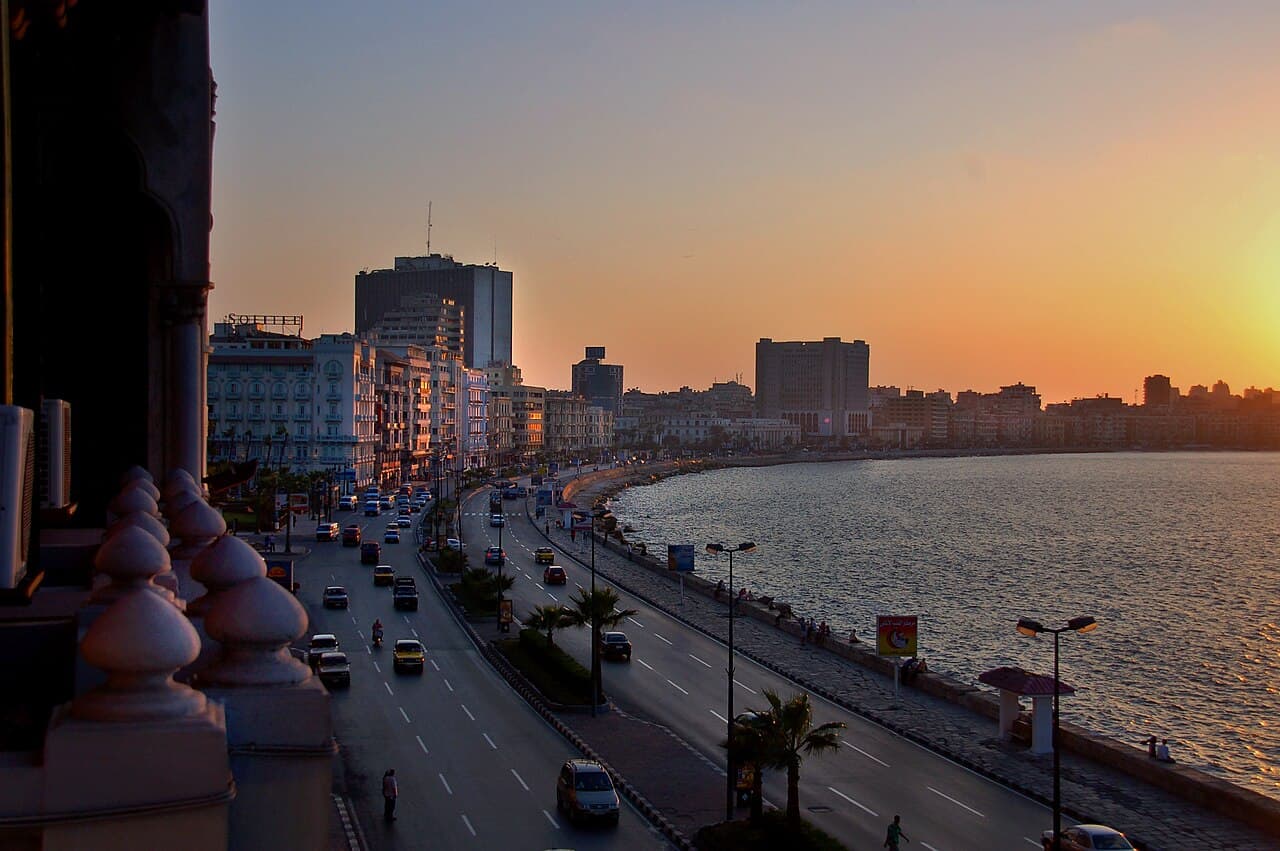
This is a reading guide, not a route or promise of access. Check your government’s latest Egypt advice, insurance and local instructions before travelling, then verify each institution’s current opening, ticket and access information. The accompanying waterfront photograph shows modern Alexandria context; it does not depict submerged ruins or prove that an underwater archaeological area is open to visitors.
At a glance
Start here
- Use Kom al-Shoqafa to examine a funerary setting where Egyptian and Greek forms meet.
- Use Kom al-Dikka to understand a late Roman and Byzantine urban complex rather than a single theatre.
- Use Bibliotheca Alexandrina’s Antiquities Museum to connect excavated objects with the city’s modern knowledge institution.
- Treat the Eastern Harbour and Qaitbay waters as protected archaeological evidence, not an assumed public dive site.
01
Begin with a city preserved in fragments
The Ministry’s Alexandria overview explains that earthquakes, later building and coastal change have left a selective record. The majority of prominent surviving ancient monuments are funerary, while urban structures remain at Kom al-Dikka and substantial evidence lies underwater. This uneven survival is not a weakness to hurry past; it is the central fact that makes Alexandria different from a temple landscape such as Luxor.
Build a mental map with three evidence zones: the living modern city, excavated land sites and the submerged ancient coast. At each stop, ask whether you are seeing an object in its original context, a structure still in place, a recovered object, or a modern interpretation. Those categories prevent a reused column or evocative sea view from being mistaken for proof of an exact ancient building.
- Label evidence as in situ, recovered, reused or interpreted.
- Do not expect the ancient city to form one walkable archaeological park.
- Use the Ministry overview to connect dispersed remains.
02
Read Kom al-Shoqafa as a funerary world
Kom al-Shoqafa is valuable because its catacombs, burial spaces and banqueting context show how death was commemorated in Roman-era Alexandria. The Ministry highlights the mixture of Egyptian and Greek beliefs and artistic forms. Look for how figures, architectural frames and ritual ideas combine, rather than treating every motif as belonging neatly to one culture.
A confined underground site demands realistic access planning. Verify current entry, stairs, ventilation, photography and any closure with the responsible authority. If the physical approach does not suit a traveller, the archaeological point can still be studied through official museum material. The destination decision should follow current conditions; the interpretation does not require forcing a difficult descent.
- Study combinations of visual traditions rather than hunting for a single style.
- Confirm the physical access conditions before arrival.
- Use museum displays as an alternative way to examine funerary material.
03
See Kom al-Dikka as an urban complex
Kom al-Dikka is often reduced to its small theatre building, but the Ministry describes a larger late Roman and Byzantine complex of baths, lecture rooms, elite houses with mosaics and workshops. Read those functions together. They reveal education, leisure, domestic display, production and infrastructure occupying the same urban district over time.
Move from the question “What is the headline monument?” to “How did people use this quarter?” A bath needs water and service areas; an auditorium implies teaching and listeners; workshops connect prestigious architecture to labour. Confirm which parts are visible on the day, because an archaeological complex can remain officially open while individual zones are restricted for conservation or work.
- Connect baths, auditoria, houses and workshops as one district.
- Distinguish a theatre-like odeion from a modern entertainment venue.
- Follow barriers even when another feature is visible beyond them.
04
Use Bibliotheca Alexandrina as a bridge
The modern Bibliotheca Alexandrina does not reconstruct the lost ancient library. Its value for this subject comes from linking a contemporary knowledge institution with an Antiquities Museum inside the library complex. That distinction protects the real achievement of the modern institution while avoiding a false claim that visitors are entering the original building.
Use the museum’s official overview to choose a collection focus. It spans Pharaonic, Greek, Roman, Coptic and Islamic material and includes antiquities from the library site and submerged contexts. Admission and collection availability are mutable and must be checked on the live institution site. Focused time with one collection can explain excavated material more effectively than a hurried photograph of the exterior disc.
- Treat the modern library as a living institution, not a replica claim.
- Check which museums are included in the current ticket.
- Verify admission and collection access through the museum’s current channel.
05
Interpret the waterline at Qaitbay carefully
The waters east of Qaitbay Citadel contain an archaeological field of architectural pieces, statues and ship remains. The Ministry associates part of the material with the Pharos lighthouse and its island, while also describing objects introduced or moved in later periods. That is a layered site, not a tidy heap in which every block can be labelled lighthouse stone.
From land, the responsible interpretation is to understand why the harbour position mattered and what underwater archaeology has recovered or mapped. Do not promise visibility from the seawall, claim that a particular shape beneath the surface is ancient, or enter the water. Access to protected submerged heritage requires current authority and professional arrangements; a public waterfront is not automatic permission to dive.
- Separate the citadel, Pharos-associated debris and later material.
- Do not identify underwater objects from a surface glimpse.
- Never assume recreational access to an archaeological zone.
06
Keep the Eastern Harbour and Abu Qir distinct
The Eastern Harbour preserves evidence associated with Alexandria’s royal ports and ancient shoreline, including mapped piers, a breakwater and probable structures in the former royal quarter. Abu Qir Bay, farther east, has a different evidence mix: submerged settlements and ports as well as shipwrecks associated with later naval history. Combining them into one “sunken city” erases geography and chronology.
Use exact site names whenever you read a display, documentary or tour description. Ask whether an object came from the harbour beside Qaitbay, the broader Eastern Harbour, Canopus, Thonis-Heracleion or a wreck in Abu Qir Bay. If the provider cannot identify the responsible authority or archaeological basis for a claim, treat the story as unverified.
- Record the named bay or harbour, not only “underwater Alexandria.”
- Separate ancient settlement evidence from later shipwreck history.
- Prefer the Ministry’s site records over a dramatic generic tour label.
07
Apply the live travel check before going
Alexandria’s archaeological value does not override changing travel conditions. The FCDO page reviewed on 2026-09-14 carried a status date of 2026-09-13, regional warnings and a reminder that insurance may be affected by travel against advice. Reopen it for the latest status, then compare your own government’s advice and any local instructions before booking rail, road or waterfront activity.
Confirm each venue directly, keep the day adjustable and avoid linking the return to an international departure without margin. If authorities restrict a waterfront, underwater activity or city movement, follow that instruction. This guide offers a method for interpreting evidence only after travel and site access are viable; it is not evidence that a route is open or safe.
- Recheck advice and insurance before committing to transport.
- Verify each institution on the day of the visit.
- Respect closures around the coast and archaeological sites.
Useful answers
Reader questions
Does the ancient Library of Alexandria still exist?
No intact ancient library building survives as a visitor site. Bibliotheca Alexandrina is a modern knowledge institution whose Antiquities Museum spans several periods and includes finds from the library site and submerged contexts.
Sources: Egyptian Ministry of Tourism and Antiquities; Bibliotheca AlexandrinaIs Kom al-Dikka only a Roman theatre?
No. The Ministry describes a broader late Roman and Byzantine complex including baths, auditoria, houses, mosaics and workshops.
Sources: Egyptian Ministry of Tourism and AntiquitiesCan visitors dive on Alexandria’s underwater ruins?
Do not assume public access. Submerged archaeological areas are protected and conditions can change. Use only arrangements explicitly authorised by the responsible Egyptian authorities.
Sources: Egyptian Ministry of Tourism and Antiquities; Egyptian Ministry of Tourism and Antiquities; UK Foreign, Commonwealth and Development OfficeAre the Eastern Harbour and Abu Qir Bay the same site?
No. They are distinct archaeological areas with different locations and evidence, including royal-port remains in the Eastern Harbour and settlements plus wreck sites in Abu Qir Bay.
Sources: Egyptian Ministry of Tourism and Antiquities; Egyptian Ministry of Tourism and AntiquitiesRead the evidence
Sources and further reading
These sources support the relevant sections above. Plans and comparisons are editorial suggestions. Check operators for current arrangements.
- Alexandria Archaeological Sites ↗Egyptian Ministry of Tourism and Antiquities · Accessed 14 September 2026
Survival pattern, Kom al-Shoqafa, Kom al-Dikka and the role of underwater archaeology.
- Bibliotheca Alexandrina Antiquities Museum Overview ↗Bibliotheca Alexandrina · Accessed 14 September 2026
Antiquities Museum location inside the library and its cross-period, site-found and submerged collections.
- Qaitbay Fort Underwater Archaeological Site ↗Egyptian Ministry of Tourism and Antiquities · Accessed 14 September 2026
Location and mixed archaeological material east of Qaitbay Citadel.
- Eastern Harbour Sunken Monuments ↗Egyptian Ministry of Tourism and Antiquities · Accessed 14 September 2026
Royal-port landscape, mapped coastline, piers, breakwater and probable submerged structures.
- Abu Qir Bay Sunken Monuments ↗Egyptian Ministry of Tourism and Antiquities · Accessed 14 September 2026
Distinct settlement, port and shipwreck evidence in Abu Qir Bay.
- Egypt Travel Advice: Warnings and Insurance ↗UK Foreign, Commonwealth and Development Office · Accessed 14 September 2026
Live travel-advice, insurance and route-status gate; status-date lag recorded in research.