Choose a Cairo museum by the story you want to understand. The Grand Egyptian Museum is designed around major ancient collections near Giza; the Egyptian Museum in Tahrir preserves both an extensive chronological collection and the experience of an early twentieth-century museum building; the National Museum of Egyptian Civilization in Fustat connects material across a much longer civilizational span. None is a substitute for the others, and trying to rush all three can turn distinct narratives into a blur.
Museum choice does not settle whether travel is viable. Check official travel advice, insurance and local restrictions separately, then use each museum’s own site for live tickets, opening, gallery availability and accessibility arrangements. The comparisons below concern curatorial focus and logistics, not a promise that any venue or route will be open on your date.
At a glance
Start here
- Pick GEM for a large purpose-built ancient-Egypt collection near the Giza landscape.
- Pick the Egyptian Museum for Tahrir location, historic display context and named collections still held there.
- Pick NMEC for a cross-period civilization narrative, textiles and the Royal Mummies Gallery.
- Confirm timed entry, collection moves, facilities and assistance directly with the chosen museum before travel.
01
Start with one question, not a checklist
A useful museum day begins with a question: how did kingship develop, how did daily practices continue across periods, or how has Egypt itself displayed antiquity? GEM, the Egyptian Museum and NMEC answer those questions differently. Decide whether you want concentrated ancient masterpieces, a historic collection in its original downtown institution, or a broad account that includes tangible and intangible heritage beyond the pharaonic frame.
Write down three object types or themes that matter most, then check which museum currently presents them. Collections can move, galleries can close and special displays can change. A decades-old guidebook may correctly describe an object but send you to the wrong building. The museum’s own collection and ticket pages should win over memory, hearsay and a package-tour label.
- Name one main historical question for the visit.
- Check current object locations rather than assuming a famous piece remains where it once was.
- Give the chosen museum enough time for close looking.
02
Choose GEM for scale and Giza context
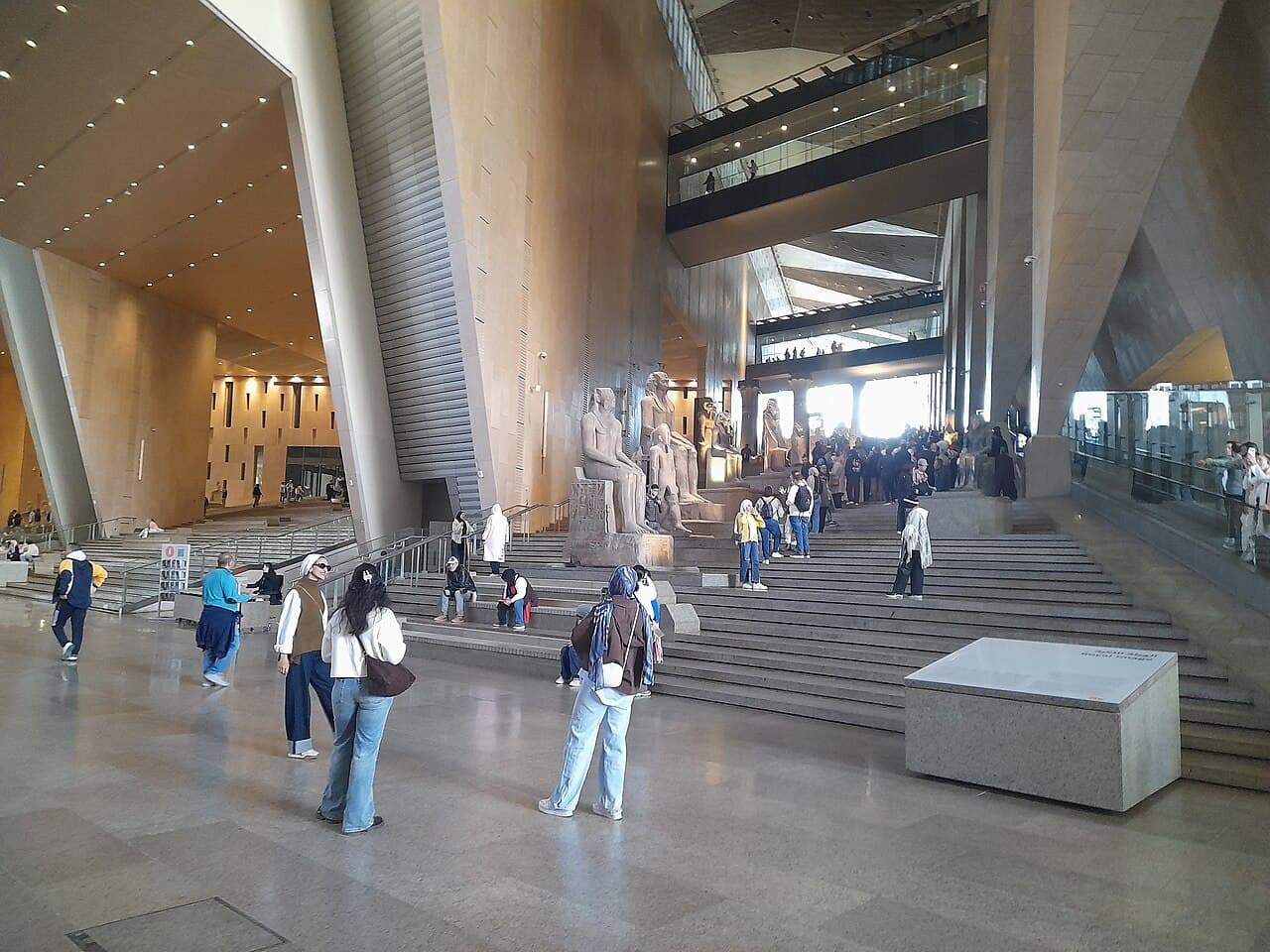
GEM sits at El Remayah Square near the Giza pyramid landscape and presents a purpose-built visitor experience around major ancient collections. Egypt’s official tourism page describes its main galleries, Grand Hall, Grand Staircase and Khufu’s Boats Museum, then points to the official ticket channel. That makes it a fitting choice when you want one large museum tied geographically to Giza, provided you resist combining it with an overfilled plateau day.
Transport deserves its own plan. Cairo’s official metro page discusses a future Line 4 station at GEM, but construction information is not evidence of current passenger service. Follow the museum’s present directions and confirm the booking before leaving. If mobility support matters, contact the museum about the specific route from arrival point to galleries rather than relying only on a general accessibility statement.
- Use GEM’s live ticket system for the selected date.
- Do not treat the proposed Line 4 stop as operational.
- Ask about the exact assistance path you need.
03
Choose Tahrir for collection and museum history
The Egyptian Museum remains a collection in its own right, not merely a former home for objects now elsewhere. The Ministry identifies material from the Predynastic to Graeco-Roman periods and names the Narmer Palette, the burials of Yuya and Thuya, Tanis treasures and royal sculpture among its holdings. These anchors make it valuable for comparing periods and studying how an encyclopedic archaeological museum took shape.
Its visit page explains a useful display logic: much of the ground floor follows chronology, while upper-floor material is grouped by category or collection. Begin with that structure instead of darting toward isolated famous objects. Sadat metro station serves Tahrir according to Cairo’s official page, but check the current route and street conditions before travelling. A central location does not eliminate city-transfer time.
- Use chronology downstairs as the visit’s spine.
- Select one upper-floor collection for depth.
- Verify any object you consider essential on the museum’s current channels.
04
Choose NMEC for continuity across periods
NMEC frames Egyptian civilization from prehistory to the present through tangible and intangible heritage. Its own site separates the Main Gallery, Textile Gallery and Royal Mummies Gallery. That structure suits readers who want to connect technologies, beliefs, clothing, settlement and state formation across time rather than concentrate only on royal objects from ancient dynasties.
The museum’s broader brief also changes how you pace it. Begin with the Main Gallery’s civilizational sequence, then choose one specialist gallery instead of treating every room as equal. Current temporary exhibitions and facilities belong to the live museum site. If the Royal Mummies Gallery is the decisive reason for visiting, verify its status directly and approach it as a human-remains display requiring quiet attention, not spectacle.
- Use the Main Gallery to build the cross-period framework.
- Add the Textile Gallery when material culture is your priority.
- Confirm specialist-gallery availability before setting out.
05
Compare logistics without inventing equivalence
The three museums occupy different parts of Greater Cairo. The Egyptian Museum connects naturally with Tahrir; NMEC belongs in Fustat; GEM lies toward Giza. Geographic grouping matters more than an abstract ranking. A traveller based near one venue may gain an hour of useful attention by choosing it, while someone linking a museum to a specific archaeological landscape may accept the longer transfer.
Ticket models and entry procedures also differ. The official tourism page directs GEM visitors to its booking channel, while Ministry and NMEC pages maintain their own visitor information. Check each institution on the same day you compare. Do not quote a fare or opening time from this article, and do not assume one ticket includes a guided tour, temporary exhibition, camera permission or specialist gallery at another venue.
- Map hotel, museum and next stop before choosing.
- Compare current official ticket inclusions side by side.
- Leave margin for security checks, cloakrooms and internal walking.
06
Make accessibility questions specific
A venue-level accessibility claim cannot answer whether your exact journey works. Ask about step-free arrival, wheelchairs, lift dimensions, seating, accessible toilets, sensory conditions, companion policies and the distance between galleries. Egypt’s official tourism page describes GEM’s barrier-free approach, tactile models with Braille interpretation and help at the Information Desk; the Egyptian Museum lists a ramped entrance and elevator among services. Confirm availability and any reservation procedure for the chosen date.
Also test the approach. A station may have a useful geographic relationship without providing the step-free path you need on that day. Contact the museum and transport operator, state the device or assistance requirement clearly, and keep a fallback gallery plan. If fatigue is the main constraint, one museum with rest points and a focused object list will usually offer more value than two hurried admissions.
- Describe the exact access requirement when contacting the museum.
- Confirm the route from vehicle or station to the entrance.
- Plan a short collection priority list with rest points.
07
Check travel viability separately
A museum’s open ticket calendar does not guarantee that your wider journey is advisable or insured. Government advice can distinguish regions, warn about gatherings or describe transport disruption independently of venue operations. Read the current advice for your nationality, check the insurer’s response and follow local authorities. Do this before a non-refundable transfer, not after the museum choice is settled.
Keep the plan changeable. If transport or local conditions make one district impractical, choose a closer cultural day only after confirming that venue too. Never treat a city-centre museum as a safety fallback by default. The purpose of this comparison is to help choose between collections once travel is viable, not to overrule a live warning or local restriction.
- Recheck advice immediately before travel.
- Ask the insurer about the full route, not only Cairo generally.
- Follow venue and local-authority instructions if circumstances change.
Useful answers
Reader questions
Which Cairo museum is best for a first ancient-Egypt visit?
GEM offers a purpose-built large-scale ancient collection near Giza, but the right choice depends on current galleries and your priorities. Check its live collection and ticket pages before deciding.
Sources: Egyptian Tourism AuthorityIs the Egyptian Museum in Tahrir still worth visiting?
Yes, when its historic museum context and current named holdings match your interests. The Ministry still identifies major collections there; verify any essential object before travel.
Sources: Egyptian Ministry of Tourism and Antiquities; Egyptian Ministry of Tourism and AntiquitiesWhat makes NMEC different?
NMEC uses galleries spanning Egyptian civilization and includes textiles and royal mummies within a broader account of tangible and intangible heritage.
Sources: National Museum of Egyptian CivilizationCan I depend on a future GEM metro station?
No. Cairo’s official page places that station within Line 4 works. Use GEM’s current directions and verify operating transport on the day.
Sources: Cairo Governorate; Egyptian Tourism AuthorityDoes an available museum ticket mean travel is advisable?
No. Venue inventory and travel viability are separate. Check current government advice, local restrictions and insurance coverage for the whole journey.
Sources: UK Foreign, Commonwealth and Development OfficeRead the evidence
Sources and further reading
These sources support the relevant sections above. Plans and comparisons are editorial suggestions. Check operators for current arrangements.
- The Grand Egyptian Museum ↗Egyptian Tourism Authority · Accessed 14 September 2026
Giza and El Remayah location, major collection and gallery framework, accessibility approach and official ticket link.
- The Egyptian Museum ↗Egyptian Ministry of Tourism and Antiquities · Accessed 14 September 2026
Collection span, named holdings, Tahrir location and listed visitor services.
- The Egyptian Museum: Visit ↗Egyptian Ministry of Tourism and Antiquities · Accessed 14 September 2026
Tahrir access, metro availability and chronological versus collection-grouped floor logic.
- National Museum of Egyptian Civilization ↗National Museum of Egyptian Civilization · Accessed 14 September 2026
Civilization-wide mission, Main, Textile and Royal Mummies galleries and visitor facilities.
- Metro Lines, Stations and Nearby Landmarks ↗Cairo Governorate · Accessed 14 September 2026
Sadat and Tahrir relationship and the under-construction status of Line 4’s GEM station.
- Egypt Travel Advice: Warnings and Insurance ↗UK Foreign, Commonwealth and Development Office · Accessed 14 September 2026
Travel-advice and insurance gate independent of venue availability.